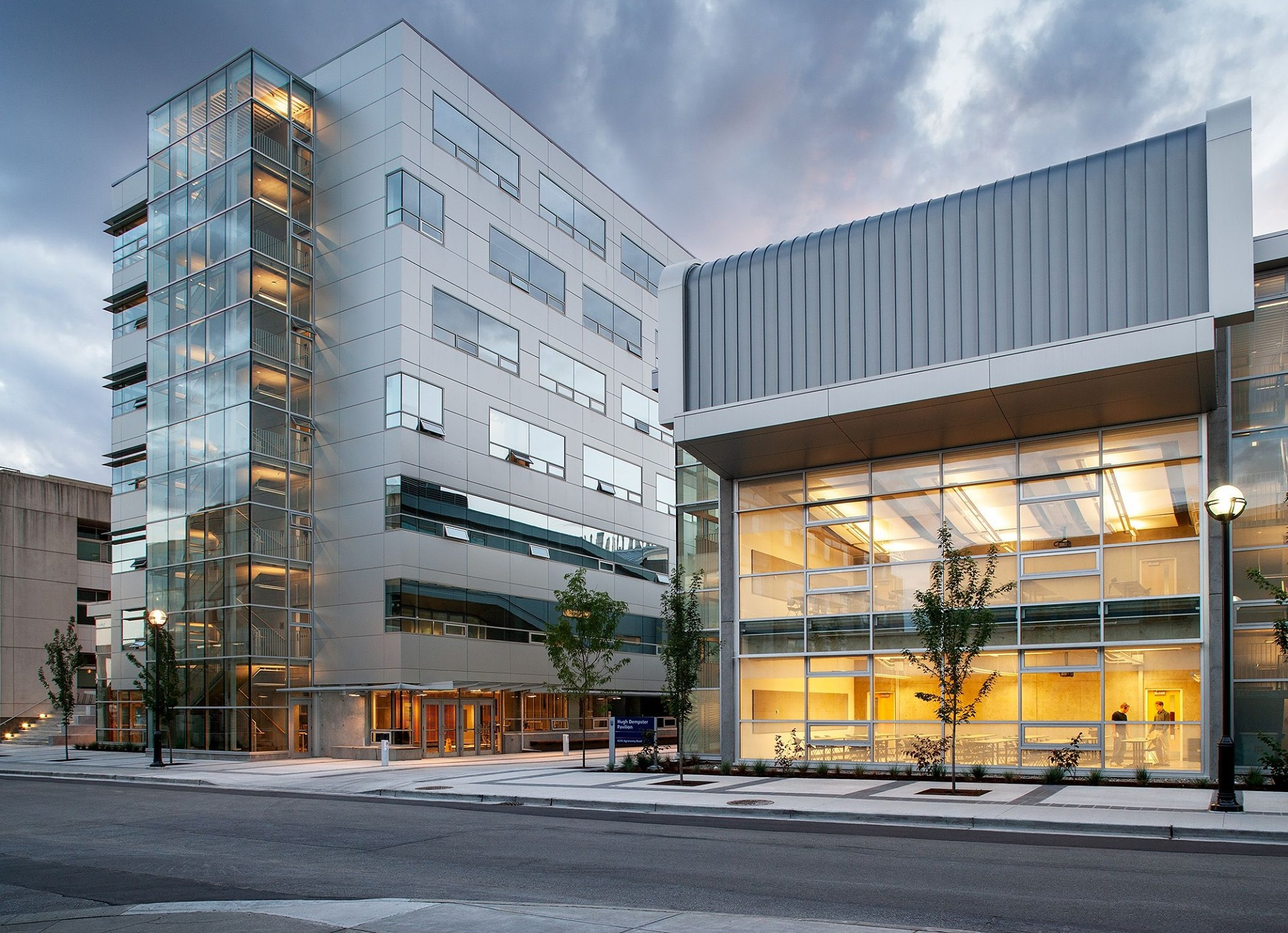
The UBC CS Student Research Conference (CSSRC) is taking place for the first time on Friday, February 27, 2026.
Our mission is to celebrate and advance graduate and undergraduate research in computer science by providing an inclusive, professional conference where UBC students can present their work, engage with academic and industry leaders, and build networks that foster innovation and career development. The CSSRC is fundamentally by students, for students, with the goal of empowering students to contribute to and partake in the research community early in their careers.
The event will feature a poster and paper submission track, with faculty and senior graduate student reviewers, modeled after established conferences. Selected submissions will have the opportunity to showcase their work during the conference in a poster session, and some winning posters and papers will receive awards!
Additionally, the event will host a 3-Minute Thesis competition, a research career panel, research presentations, and networking opportunities.
Join us on February 27 at the ICICS/CS Building. Feel free to learn more about the program on our Program Schedule page, or join our Discord if you have any questions!
| Submissions | Deadline |
| Title + Abstract (max 250 words) | January 12th |
| Full Submission | January 19th |
| Notifications | February 1st |
| Camera-ready Deadline | February 18th* |
| Conference Day | February 27th |

Dr. Kelsey Allen is an Assistant Professor of Computer Science and Psychology at the University of British Columbia, bridging computational cognitive science, machine learning, and robotics.
Her research explores how humans and machines adaptively solve complex challenges through innovative tool use and flexible problem-solving. With a background spanning physics, cognitive science, and artificial intelligence, including a PhD from MIT and research experience at DeepMind, Dr. Allen investigates the computational mechanisms that enable intelligent tool creation and environmental adaptation.

Saurabh Saxena is a Staff Research Engineer at Google DeepMind, where he leads research at the intersection of computer vision and generative modeling.
His work in generative AI explores the potential of diffusion models for creating controllable image and video content. On the scene understanding front, his research is centered on methods for recovering intrinsic properties of a scene, such as its geometry and motion, as well as estimating camera parameters. Prior to this, he played a pivotal role in building and launching TensorFlow 2, leading foundational aspects like automatic differentiation, control flow, and eager execution.

Tim Straubinger currently works at Industrial Light & Magic, doing VFX R&D.
Previously, he received his master's degree in Computer Science at the University of British Columbia, under the supervision of Robert Xiao and Helge Rhodin, with Imager Lab and the Computer Vision Lab, where he worked on acoustic reconstruction using machine learning and wave simulation.
He has also worked at Vital Mechanics Research, working on garment and soft tissue simulation.

Nodir Kodirov currently researches cloud systems for AI inference at Huawei Canada. He has also worked on graphics systems and datacenter networks. In his current role, he applies systems, graphics, and networking skills to build high throughput AI inference systems.
Previously, Nodir earned his PhD in Computer Science from the University of British Columbia, where he was advised by Ivan Beschastnikh and Alan Hu, at the Systopia Systems lab.